

Division 296 Superannuation Tax is now law — what it means for high-balance SMSFs
The Federal Government has now passed legislation introducing Division 296, marking a significant change to the taxation of very large superannuation balances.
The legislation passed Parliament in early March 2026 and will apply from 1 July 2026.
What is Division 296?
Division 296 introduces an additional personal tax on superannuation earnings for individuals whose total superannuation balance exceeds $3 million. The tax applies only to the portion of earnings attributable to balances above the thresholds and does not cap how much can be held in superannuation.
Key points at a glance
Commencement date:
Division 296 applies from 1 July 2026, with the first assessments relating to the 2026–27 financial year.
Who is affected:
Individuals with a total superannuation balance exceeding $3 million, across all super funds (including SMSFs, industry and retail funds). To be clear, please note that for a SMSF it is not the total fund balance that is subject to the tax. The tax is levied upon the individual members in that fund whose balances exceed $3m.
Additional tax rates:
- Earnings attributable to balances above $3 million: additional 15% tax (effective tax rate ~30%)
- Earnings attributable to balances above $10 million: additional 25% tax (effective tax rate ~40%)
How is the new tax calculated?
The formula is:
15% x proportion of the member’s super over $3m x earnings
Plus 10% x proportion of the member’s super over $10m x earnings
Taxed to the individual:
The Division 296 tax is assessed to the individual, not the super fund. Individuals may elect to pay the tax personally or have it released from their super, similar to the current Division 293 arrangements where an additional 15% tax is levied on contributions for individuals with income > $250k.
No tax on unrealised gains:
Unlike the first draft of the legislation, the final legislation does not tax unrealised capital gains. Only realised earnings are included in the calculation.
Special treatment for unrealised capital gains accrued before 30 June 2026:
An SMSF may choose to reset the cost base to market value on all its assets at 30 June 2026 for the purposes of calculating Division 296 earnings in future years. This enables an adjustment so that only the increase in value since 30 June 2026 is included in Division 296 earnings. This has no impact on the actual capital gain included in the SMSF tax return in a year when an asset is sold. The choice must be made for all assets in the SMSF at 30 June 2026, there is no option to pick and choose.
Thresholds are indexed:
The $3 million and $10 million thresholds will be indexed over time with inflation, in increments of $150,000 and $500,000 respectively.
Transitional rule:
Importantly, for the 2026–27 income year only, the Division 296 tax liability will be determined solely based on the total super balance at 30 June 2027, providing time for affected individuals to review their position. For subsequent financial years, the liability will be based on the greater of the opening total super balance at 1 July and the closing total super balance at 30 June.
Key calculation steps
- Determine the proportion of the individual’s total super balance that exceeds $3 million (and $10 million if relevant).
- Determine the amount of Division 296 earnings in the super fund attributable to the individual.
- Apply that proportion to the individual’s Division 296 earnings.
- Apply the relevant additional tax rate to that attributed earnings amount.
Here is an example:
Peter (66) has a total super balance of $11m at 30 June 2027, all in his SMSF. The proportions would be:
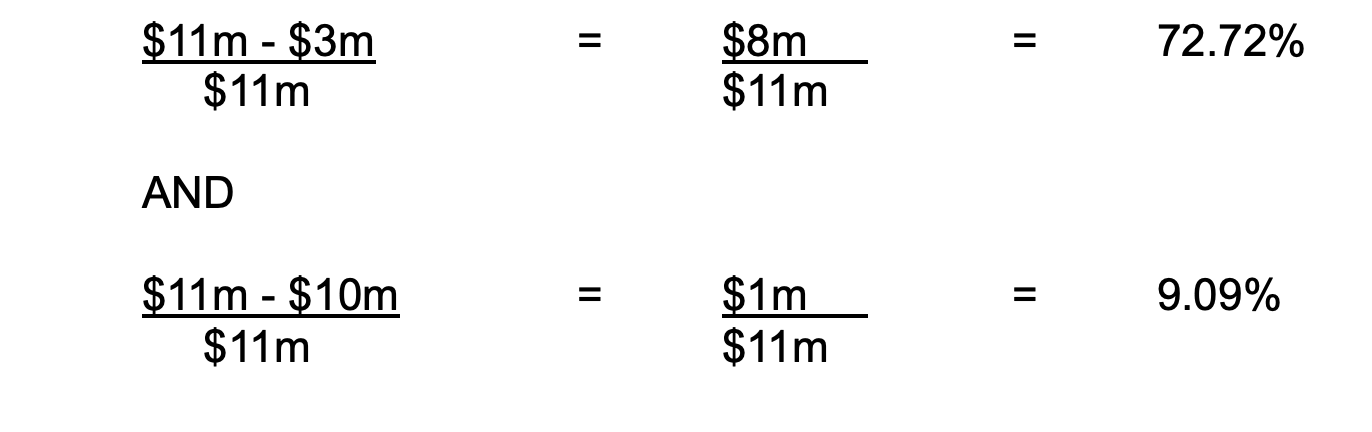
The Division 296 earnings in the SMSF are calculated as follows:
| Dividends | $250,000 |
| Franking credits | $110,000 |
| Capital gain less 1/3 discount | $80,000 |
| Rent | $60,000 |
| TOTAL INCOME | $500,000 |
| Expenses | ($20,000) |
| EARNINGS FOR DIVISION 296 | $480,000 |
- The fund’s contributions and exempt pension income deduction are ignored for this calculation. If the fund has carried forward capital losses these may be offset against the capital gain above.
- Peter’s wife Sara has a balance of $2M in the SMSF as well so an actuarial certificate is required to determine the amount of earnings attributable to Peter. We assume this is 85% resulting in Earnings allocated to Peter of $408,000.
- As a result Peter’s Division 296 tax is calculated to be:
15% tax x 72.72% x $408,000
Plus 10% tax x 9.09% x $408,000
Tax payable = $48,213
Some key considerations
The introduction of Division 296 results in a major shift for clients with high superannuation balances. Proactive planning and tailored advice are essential to manage the impact on superannuation outcomes and broader wealth strategies. We will be actively looking at our clients’ financial circumstances and there are things that can be done now in the lead up to the start of the new rules. Consider the following:
- In an SMSF, review the unrealised gains and losses to assess the tax implications of retaining assets, disposing of assets, or applying the CGT cost‑base reset.
- Arrange valuations for 30 June 2026 for property held in the fund or related unit trust and any unlisted investments so that the asset values are accurately recorded in the SMSF financials.
- Review superannuation balances between spouses to identify any planning opportunities.
- Consider estate and succession planning arrangements to identify any new risks as a consequence of making changes to superannuation/retirement structures or to identify any opportunities that may help to simplify or accelerate planning.
- Importantly, because of the transitional rule discussed above for the first year of the tax, there is time to review, plan and take action to optimise your financial arrangements.
Please contact us if you would like to review how Division 296 may apply to your circumstances.
CONTACT ALLAN HALL SUPERANNUATION