

The Key Numbers
SpaceX listed on the Nasdaq on 12 June 2026 under the ticker SPCX. The largest IPO in history.
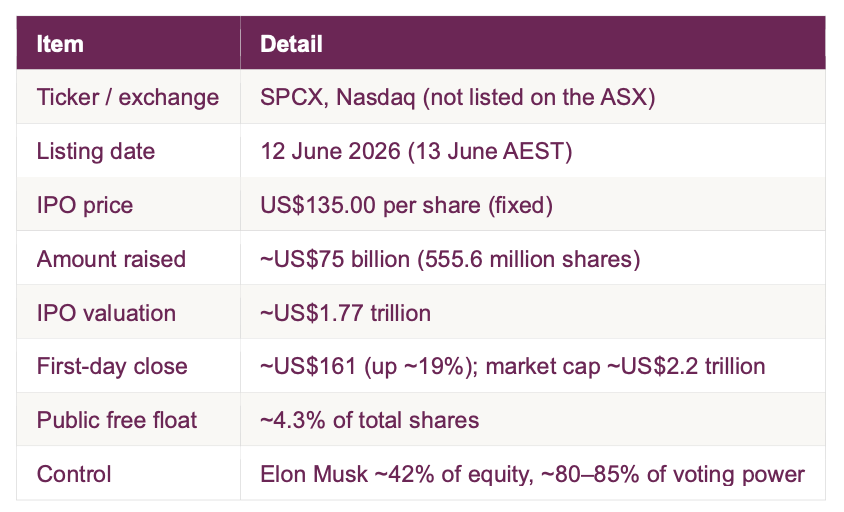
SpaceX priced its initial public offering at a fixed US$135 per share, implying a pre-listing valuation of approximately US$1.77 trillion. The offer attracted exceptionally strong investor interest, with demand reaching roughly four times the amount available by the time the books closed.
Since its trading debut, SpaceX stock has continued to climb, trading at around US$192per share as of 15 June. The gains have lifted SpaceX’s market capitalisation to approximately US$2.51 trillion, keeping the company among the ten most valuable listed companies in the world.
What is SpaceX?
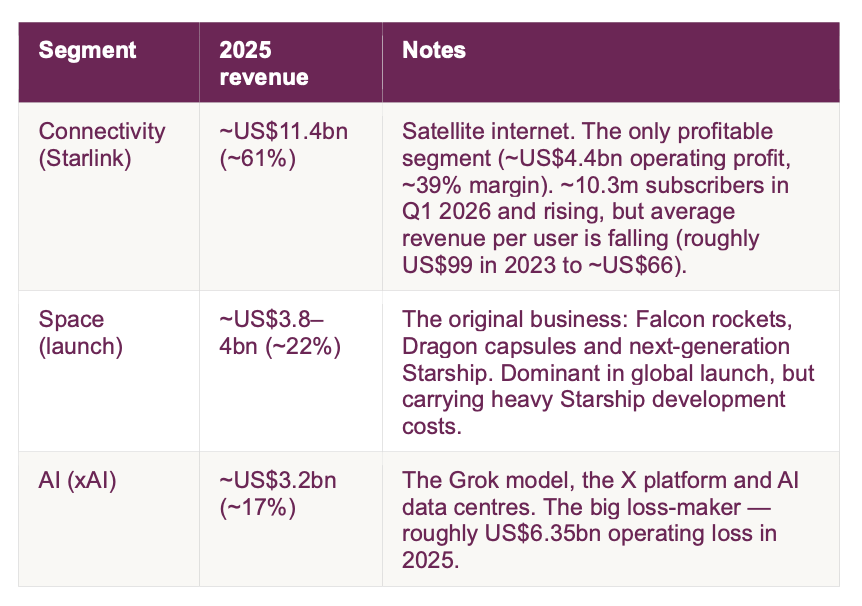
SpaceX was founded in 2002 by Elon Musk as a rocket and satellite company. In February 2026, it broadened its reach considerably by acquiring Musk’s artificial-intelligence company, xAI. Today, the company can be broken down into three key businesses.
How does the IPO rank against history?
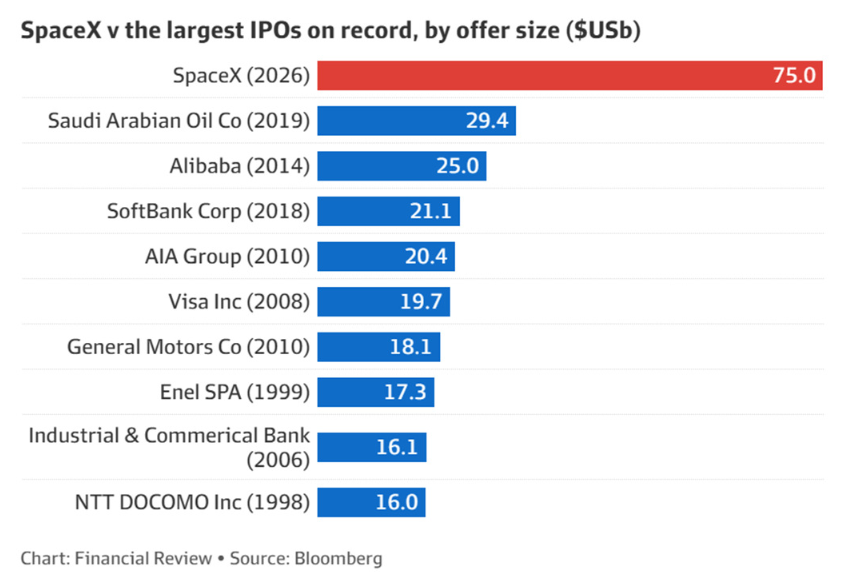
At roughly US$75 billion raised, SpaceX is the largest IPO ever, nearly three times the previous record, Saudi Aramco’s US$29.4 billion in 2019, and more than triple Alibaba’s US$25.0 billion in 2014.
Private investors cashing in?
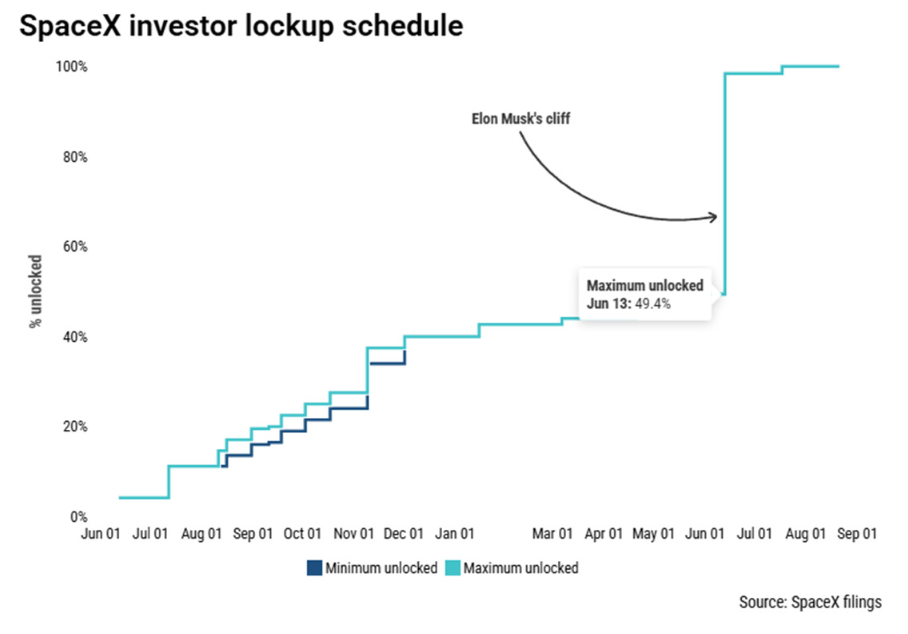
Nearly all of SpaceX’s existing shareholders were unable to sell into the IPO and will remain restricted from doing so for some time under lock-up arrangements.
Some investors will be permitted to sell up to 20% of their restricted shares following the company’s second-quarter earnings, with further incremental sales scheduled between 70 and 135 days after listing. Elon Musk, who holds the majority of SpaceX’s shares, will be required to wait 366 days from the IPO before he is able to sell.
Index inclusion: when and how much?
S&P 500 — not yet, and not automatically
S&P Global retained its profitability requirement and, citing SpaceX’s substantial 2025 loss, declined to grant the company fast-track entry. As a result, index funds and ETFs benchmarked to the S&P 500 are not mechanically obliged to acquire SpaceX shares.
Nasdaq-100 — likely within weeks
Nasdaq introduced a “fast entry” rule, effective 1 May 2026, permitting very large new listings to join the Nasdaq-100 after as few as 15 trading sessions, provided they rank among the 40 largest constituents by market capitalisation, a threshold SpaceX comfortably exceeds.
Holders of Nasdaq-100 products, such as Invesco’s QQQ or BetaShares’ NDQ on the ASX, would therefore gain exposure within weeks, albeit at a weighting that analysts estimate at under 1% of the fund.
FTSE Russell — June 26, 2026
SpaceX will be added to the Russell 1000, Russell Top 200 and other Russell US indices, effective after the close on June 26, 2026, under the new fast-entry rules, alongside eligibility for the FTSE Global Equity Index Series.
MSCI — June 29, 2026
MSCI announced on June 8 that it will apply its existing early inclusion rules for SpaceX’s to be included in its Global Standard Indexes. SpaceX is expected to be added to the indexes roughly ten trading days after it starts trading on June 29.
The MSCI Global Standard Index is the most relevant development for Australian investors, as it includes both the MSCI World Index (developed markets) and the MSCI ACWI (all-country world index), benchmarks commonly used by Australian-domiciled global equity funds, both passive and active, albeit the weighting is expected to be very small.
Are active fund managers buying SpaceX?
While Munro Partners and Plato Investment Management have been publicly reported as participating in the SpaceX IPO, most active fund managers have been reluctant to take the leap, citing the following concerns:
- Limited free cash flow generation and an absence of profitability. The company is consuming cash at pace, driven largely by its investment in AI. Starlink is its only profitable division, accounting for approximately 69% of total revenue. SpaceX has yet to record an annual profit and posted a net loss of roughly US$4.94 billion in 2025.
- A valuation that appears stretched relative to fundamentals. At around 100 times revenue, the company is richly priced. The range of possible outcomes from here is exceptionally wide and the odds of each are genuinely hard to pin down. In effect, a significant part of the company’s price today reflects the value of what the company might one day become, rather than what it earns now.
- A very small free float and governance concerns. Only around 4% of the company is publicly traded, and its dual- class structure leaves Musk with approximately 82% of the voting power. For active managers, a low float means limited liquidity and difficulty building or exiting a position, while concentrated founder control constrains shareholder influence.
CONTACT ALLAN HALL FINANCIAL PLANNING
Related reading
General Advice Warning
The information contained in this article is general in nature and does not take into account your personal situation. You should consider whether the information is appropriate to your needs and, where appropriate, seek professional advice from a financial advisor. This site is designed for Australian residents only. Nothing on this website is an offer or a solicitation of an offer to acquire any products or services, by any person or entity outside of Australia. Robin Bell, Martin Cimino, Angelo Adam and Allan Hall Financial Planning Pty Ltd are Authorised Representatives of Consultum Financial Advisers Pty Ltd ABN 65 006 373 995 AFSL 230323.
This document is prepared by Rhombus Asset Management Pty Ltd (ABN 12 676 473 868) (AFSL 558013) (‘RAM’).
General Advice Warning: The information in this report is general advice only and does not consider the financial objectives, financial situation or needs of any particular investor. This report and its contents are current as at the date of issue but may be subject to change at any time.
In preparing this report, RAM has relied on information and assumptions available to it at the time of production. This may include information that has been provided to RAM by third parties. RAM does not guarantee the accuracy or reliability of information provided to it by third parties. Nothing in this document including any statements or opinions expressed by RAM may be relied upon as a promise or representation as to the current or future status or likelihood of any event or activity. Past performance is not a reliable indicator of future performance and should not be relied upon when making any investment decisions.
Before doing or declining to do anything in response to this report, you should assess your own personal financial objectives, needs and circumstances and seek personal financial advice from a licensed financial adviser.
RAM, its directors, officers, employees and agents expressly deny and disclaim any liability for any errors or omissions in this report, and/or any losses, liabilities, costs, claims or expenses whether direct or indirect or current or future arising out of or in any way relating or connected to the content of this report and any any reliance on it from any party. This report is not available for distribution outside Australia and may not be distributed to any person other than the intended recipient without prior written consent from RAM.